Thursday, 23 March 2017

Aberdeen

Geoff and I headed off on our ‘grand tour’ of Scotland – Shetland, via Aberdeen.   


We flew into Aberdeen, ate lunch in a castle, did a quick turn around the city and headed off to the ferry to Shetland. 


Perhaps that’s over simplifying Aberdeen – we weren’t really there for long enough to get much sense of the place.  It was a glorious, sunny day and the granite buildings all looked spectacular – especially the council buildings near Marischal Square


Geoff managed to squeeze in his first haggis meal of the trip – assuring me that there would be many more to come.  


Then it was off to the ferry for the overnight trip to Shetland, which wasn’t delightful, but was perfectly comfortable (if a little cold on the ferry itself).  The view from the upper deck as we left Aberdeen was glorious.


Though it was incredibly wind – which really was an indication of the way things would be in Shetland.  


And certainly the wind continued out on Shetland!

Monday, 20 March 2017

Composition rounds 2 and 3

I much prefer the artistic, or creative, challenges – rather than the technical! 

Rule of thirds / Odd numbers / Diagonals 


You need to imagine your frame has been divided into a 3x3 grid – not quite square, as your frame isn’t.  Then the challenge is to try and place the subject on those lines.  A connected concept is the idea that humans prefer odd numbers, so if you are going to have multiple objects forming the subject, then you should aim to have 3 or 5 of the object.  In this photo of the squirrel you can see that he almost on the left vertical ‘third’ line.


The other connected concept is the idea of taking photos that contain diagonal lines, which tend to create a dynamic image.  I really like to use this when taking photos of buildings, to really give the impression of the building soaring into the sky.

Leading lines / frames / ring of light


An easy way to focus attention on a subject is to visually lead the eye to it.  One way is through the use of lines – more commonly you may use the footpath, or a road, but in this image the line of the cannon neatly directs you to Geoff’s lovely face!


Another way to is to create a frame within the image – like this image of me standing in the doorway in a side street in Krakow.  It would be even more effective if the image was of me through the doorway, but I wasn’t just going to let myself in. 


Another version of a frame is to surround the subject with a ring of light – not in the 1980’s way of creating a halo and minimising wrinkles, but ideally to maintain the colour accurately and highlight the subject.  This one is easier in natural light, but I had fun trying to create the effect with a street light and a shrub.

Background separation


I’ll take any excuse to play with depth of field when taking photographs – and my camera actually defaults to that when on the auto setting if the subject is far enough forward of the background (and close enough to the camera). Blurring the background in this shot really draws attention toblossoms.

Thursday, 9 March 2017

Composition exploration – the basics


After a few weeks of very technical emails, which I muddled through with varying degrees of success, I was pleased that A Year With My Camera has started a 4 week focus on composition.  I have studied it in the past, but Emma presented the first week in a way that I had never considered – focussing on the background, foreground and subject. 

My previous thoughts on composition have been guided by geometry, and looking at the relative heights of the different elements of the image, so I initially found the descriptions of ‘more foreground’ or ‘more background’ a little confusing.  I found it more helpful to think about the percentage of the frame that the background or foreground should fill (‘more’ meaning a higher percentage). The challenge was to take 5 images, and focus on moving your feet to achieve them rather than moving your feet!

A balanced image


A lovely, though boring, image of Geoff on the path beside the Kelvin river.

Mostly subject


Up close in the Glasgow Botanic Gardens glasshouses on a beautiful flower from a plant native to Indonesia. 

Mostly background


Again beside the river, the mossy stump is the subject and while I usually would have framed the image to crop our the path in front, I deliberately left a little in the corner of the image to clearly have some foreground. 
 
Mostly foreground


A windswept Geoff on the upper deck on the ferry out to Lerwick, Shetland Islands (and the wind was impacting me as well, hence he is a little blurry!  The sunse over Aberdeen was spectacular. 

No foreground


I guess a flatlay is a good example of no foreground, but I am not sure how technically these are shot – but the opposite of a flatlay is looking straight up, so I flipped about the screen on my camera so I could see the shot and took the image straight up in the Glasgow Botanic Gardens glasshouses

Sunday, 19 February 2017

Weekend in Cardiff

Geoff and I had a great time in Cardiff last weekend – we ate our bodyweight in welshcakes (before we found out how much lard was in them) and really enjoyed walking around Cardiff, a beautiful, small town, about 2 hours from London by train.


We had unwittingly booked our weekend in Cardiff to coincide with the England v Wales rugby match.  Luckily, Welsh rugby fans are remarkably relaxed even when they lose, and there wasn’t much noise following this loss.  Timing our visit this way meant that on Saturday the city centre was packed with fans, people offering daffodils (the Welsh flower), selling scarves and doing face painting – quite a carnival like atmosphere. 


As well as the delicious welshcakes, we ate a huge ice cream sundae in honour of Geoff’s 34th birthday, some delicious cupcakes and fabulous pasties with welsh rarebit inside. 


We explored the castle and park, wandered through the pretty city centre and down to the marina area where we went insidethe Senedd (the Welsh parliament).  


The Senedd is beautiful - all made of glass and curved wood - and hosts 60 parliamentarians, as well as the staffers.  


Cardiff was a really interesting mix of old and modern, with most things still far below London prices!

Friday, 10 February 2017

The top with the magic neckband


The Sew Over It Molly Top (a pattern in the City Break e-book) is a pretty basic jersey top with a slightly scooped neckline and cut on sleeves. It comes as both a top and a dress pattern, and I’ve made 3 of the tops for myself. 


The first was from a very drapey maroon viscose jersey that I wear with navy/maroon checked PJ bottoms.  I made this version exactly as per the pattern, and while it is very comfortable I made just one tweak to the pattern after making it.  Firstly, I raised the cut on sleeve back up the arm by 8cm.  I found the very low attached sleeve too sloppy looking, and slightly irritating almost in the crook of my elbow.  I lengthened the sleeve by the same amount and think this is a much neater look.

The best part about the pattern is the neckline.  It’s a great gentle scoop and each time I have made it the band has been the right length to stitch on without fussing around with it.  It is quite wide, which gives it a casual look, and in very drapey fabric I would recommend a slightly narrower band as I think it looks too loose.


I’ve not made any curved hem versions yet, but assuming that I am going to make another I will tackle that then – I am thinking about a striped body and plain sleeves (same colour as the background colour on the striped fabric).  Now to find the right pair of fabrics…

Sunday, 5 February 2017

Just 1 length of thread per day


Back in August last year I spotted some vintage silk panels on sale at Fabric Godmother, and while there were some pattern suggestions, I thought that it would be best as a square scarf to really show off the distinctive print. 


When the panel arrived I was happy to see that it was a beautifully textured silk, almost a basket weave texture, but as it’s quite loose I knew that this would be a hand-sewing job.  And of course, I put it off.  And off.  Finally, I committed this year to the theme of ‘Active’ and I decided that included no more procrastination (so I mended a pair of Geoff’s trousers), and set to work sewing a hand rolled hem around the edge of the silk panel.


I committed to 1 length of thread per day, though could do more if I felt like it.  Sometimes it seemed to fly by.  Other days I struggled to do just the 1.


The Colette tutorial suggested sewing around the edges, ¼ of an inch in, as a guide, but given the age and weave of the fabric I was reluctant to do that.  Instead, I followed a hand sewing only tutorial.  My stitches were not perfect, and certainly were not simply just 1 thread of the fabric, but I am very pleased with the end results and love wearing my garlic scarf.

Wednesday, 1 February 2017

Bus smudges

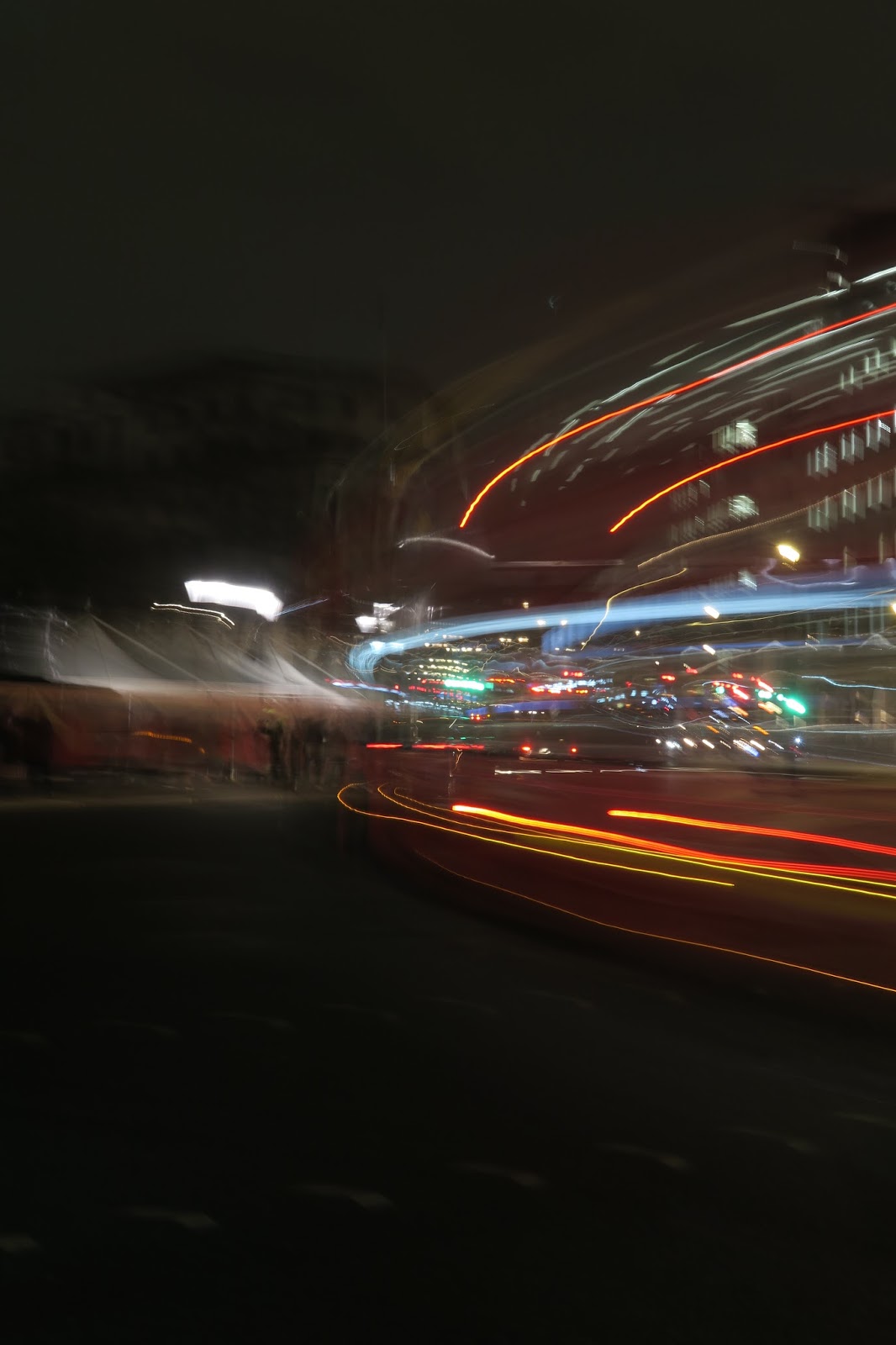
The photography challenge over the weekend was to experiment with shutter speeds.  
 

This isn’t something I’ve really tried before – and before I read the AYWMC email, I didn’t have a clear understanding of the effects that could be achieved. 


My old camera had a setting that allowed the shutter to remain open while my finger was on the button, but I didn’t really use it. 


This camera has shutter speeds as slow as 15 seconds (by the way, is anyone else confused as to why the symbol for seconds is the same as the symbol for inches), and super, super fast – too fast for the amount of light I had available to me on Friday night, standing at the base of Nelson’s column in Trafalgar Square. 


I experimented with buses and traffic, going towards Big Ben, under the Admiralty Arch, and then side on, to get some bus smudges. 


There was a trick – the bus had to be moving quickly enough for this to work – that is, enter and exit the shot area while the shutter was open, which meant only shooting while the bus was coming at a green light.


Then I had to think about framing, and trying to exclude some of the traffic signage from the shots. I really want to try this again with sparklers – a long shutter speed is how to capture messages ‘written’ in sparklers.