When it comes to accessories, I rarely knit the same pattern twice.
However, when it comes to garments, the opposite is true. I love to
find a basic pattern that I can tweak through stitch patterns, yarn
choice and by lengthening/shortening the different elements.
One
such pattern is the Whisper Cardigan, designed by Hannah Fettig and
first published in Interweave Knits in Spring 2009. If you click
through, you will see that the Whisper has bell sleeves, wispy, curly
tails in the front and is quite cropped (8 inches from the underarm if
memory serves). None of these elements are particularly appealing, but I
really liked the idea of the cardigan. So I set about making it work
for me, and then knit it twice more for good measure. My modifications
are sleeve shape, increases on the body rather than the short rows,
edgings to minimise rolling, and some lengthening.
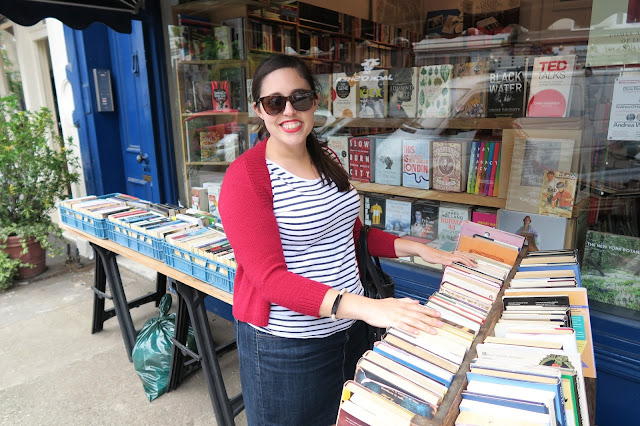
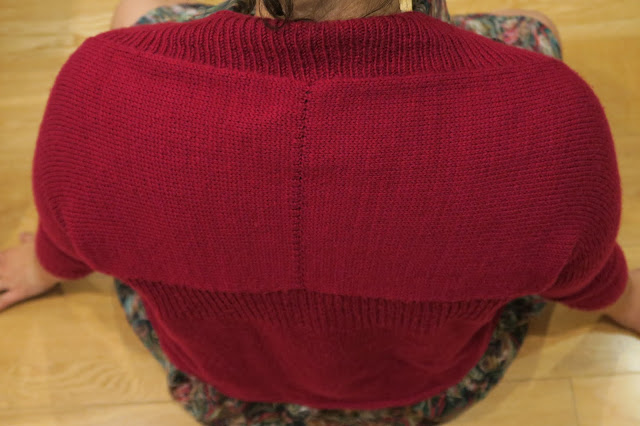
Firstly,
the sleeve shape. Instead of casting on vastly more stitches than
required, I cast on almost a sock cuff and knit ribbing for more rows
than I cared to, before switching to stockinette and knitting increases
at set intervals to the underarm. I knit as per pattern across the
back, as I really like the little gathering detail, and as per pattern
for the ribbing all around the shrug portion.
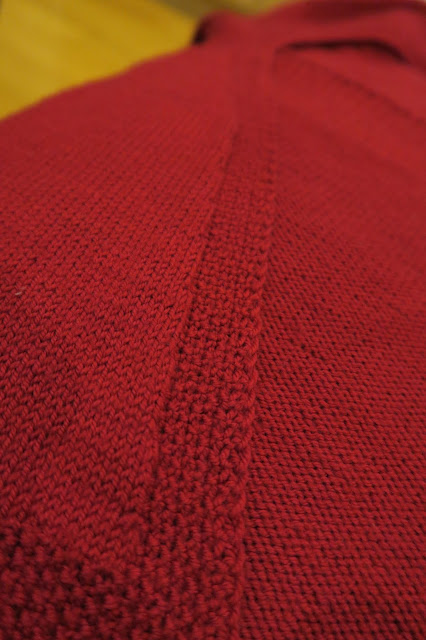
On
to the body, rather than knitting short rows and ending up with
considerable ‘tails’ on the front, I knit increases on the skirt –
starting with every right side row for 3 inches and then tapering off to
every 3rd right row, then every 4th, until the
end. The increases are immediately after the edging stitches – which is
another modification that I have repeated (though with different
patterning) to minimise the rolling. I did garter rib on the first
Whisper but for numbers 2 and 3 I’ve used seed stitch. I kept the first
stitch as stockinette on the right side and then had 7 seed stitches of
edging. I then used seed stitch on the bottom of the cardigan, for 10
rows. I like the seed stitch edging as it lies flat on the sides and
doesn’t pull in so the cardigan still drapes nicely.
The
yarn was heavenly – a little cashmere sure makes a difference! Lovely
to knit with, and I alternated skeins through the back (flat knitting
only) but didn’t need to because the dye is consistent. The red is a
great true, blue-based red, almost my perfect colour, and the little
cardigan is just the thing for a London summer (or a Melbourne spring).
This past weekend Geoff and I spent a very enjoyable, and sunny bank holiday weekend in Canterbury and Whitstable.
We
stayed very close to the castle ruins, and set off to explore them
after we had put our bags down where we were staying. The castle was
built in about 1070 and was a prison for much of its useful life,
eventually being a ruin sometime in the 17th century. It’s
quite accessible – you can wander in, climb most of the way up a tower
and marvel at how small it is inside as those stone walls are incredibly
thick.
During what shaped
up as a gloriously sunny afternoon, Geoff and I meandered along the
‘Great Stour’, a trickle of a stream that does not deserve either the
moniker ‘great’ nor ‘river’. We had a delicious lunch from The Goods
Shed, and ate cake and drank coffee in the sunshine. The Goods Shed was
positively laden with local produce, gleaming red strawberries,
luscious asparagus and heavenly smelling bread and biscuits, and we
partook across the board. A pity it was not open on Monday, as we would
have liked to taste more of the offerings.
We
attended the Choral Evensong service at the Canterbury Cathedral, and
enjoyed the choir and surroundings. The Cathedral is undergoing
significant repair, and likely will for some time, so the scaffolding
impinged on the view of the Cathedral as a whole, but it was lovely to
explore nonetheless. We were on the hunt for the most recently buried
person, but couldn’t come up with anyone in the last 500 years!

On
Sunday we took the bus to Whitstable, about half an hour away from
Canterbury and on the seaside. It’s difficult to describe it as the
beach, as it was mostly rocks in place of sand. A very crowded
boardwalk runs between the fisherman huts and the boats, and the tide
was a long way out when we arrived. We explored the little marketplace
at the harbour, and enjoyed some delicious oysters, as well as a
milkshake and donut (Geoff can be relied on to find them). Finally we
worked up enough of an appetite to enjoy simply delicious fish and chips
at a little cafe on the beach – a piece of cod, a piece of skate, and
very freshly cooked chips that were nice and crispy. Skate is a tricky
fish to eat deep fried, but we managed to enjoy it rather inelegantly!
Monday
was the only let down, weather wise, but we enjoyed our overcast walk,
nice coffee and delicious lunch before heading back to London.
On occasion, I have been known to say that I miss Spotlight! Which is sacrilege really - the yarn selection is mostly acrylic (not my thing) and you can get better fabrics at cheaper prices at the fantastic fabric shops in Melbourne. However, sometimes you just need a spool of thread, or a black invisible zip, or something equally as mundane.
Welcome to Camden, Ultimate Craft! It's about 20 minutes from my house, and as it's open until 7pm most nights, I can easily pop down and pick up any last minute supplies.
Full thread selection, lots of zips and buttons, decent fabric for lining, or contrast pockets, but probably not for garment sewing, and almost all acrylic yarn! It's practically perfect in everyway.
At the risk of stating the obvious, there are a large number of
knitting patterns available these days – magazines, books, ravelry and
blogs; free and for sale. And more appear every day – I can’t keep up.
The silver lining to this problem is that I never need to knit the same
pattern more than once if I don’t want to. Sometimes I do want to, but
that is a topic for another day.
I
often find myself with between 50 and 100 metres of sock wool, as a
pair of socks for my delicate feet rarely require even 300 metres. I
collect these oddments, but I don’t enjoy them sitting there,
aimlessly. Instead, I look through my favourite hat patterns and often
end up knitting worsted or aran weight patters in the sock wool, and end
up with a collection of baby hats.
I
really like the folk art inspired Karusellen hat, but it is a bit too
cutesy, and not the right shape of hat, for me. So I cast on the
requisite number of stitches, and knit as per the chart. While knitting
I thought the hat was getting too tall, so ideally I would have started
the decreases whilst knitting the coourwork chart, but instead I did
the decreases fairly speedily.
I
then turned my attention to the Coronet pattern, already knit in sock
wool, but I repeated the colourwork pattern as I thought a mainly navy
hat for a baby was quite heavy.
Finally,
I used the Stashbusting Helix Hat pattern. Again, a worsted weight
pattern and again I used sock wool. I did the first one with 3 yarns,
as per the pattern, and for the second version I used 4 yarns and added
an extra colour change point.
This
was a great way to use up the oddments that were idling in my stash,
and try some patterns that are interesting or appealing, but not
necessarily something I want to wear.

Apart from the stunning collections held by the national
institutions, London is home to a huge number of private art galleries.
And most of them are quite welcoming to all guests, even those who
clearly aren’t going to be making a purchase! Geoff and I like to wander
in, acting like we sort of know what we are doing, and avoid eye
contact or any awkward questions.
Sometimes
these private galleries are easy to find, and packed with visitors.
Like when we saw the Steve McCurry exhibition at Beetles & Huxley,
you know, he of the famous Afghan Girl TIME magazine cover. We were
three deep in front of the limited edition print, and there were people
outside trying to take photos of the photo. The remainder of the
exhibition was equally as visually stunning – McCurry has a very strong
eye for colour.
On other
occasions the galleries are still easy to find, but the shows are not as
intensely popular, so we can enjoy the pieces with clear space between
ourselves and the next person. Over the weekend we visited 3 small
galleries, all on various side streets jutting off Regent Street (after eating burritos for lunch).
Firstly,
we saw the Ettore Spalletti ‘Every dawn, is first’ at the Marian
Goodman Gallery. Spalletti combines painting and sculpture to create
large, mostly monotone, canvases that torque off the walls in different
directions. The cavernous exhibition space emphasises the vertiginous
feeling, as even whispers echo around the room. The most visually
arresting work was two canvases, painted a summery sky blue, that came
towards us, and each other, and as they reflected the blue light was
luminous.
Over the road at
Pace London, we saw another painter/sculptor, Keith Coventry and his
exhibition ‘White Black Gold’, who created beautiful curves slightly
raised from the canvas, either all white or gold, to create beautiful
lines and subtle shadows. The curves are apparently the famous golden
arches, but not obviously so, even when the canvas is cast in gold.
Finally,
at the Stephen Friedman Gallery we saw a quirky exhibition, ‘Horizon
That Appears Out of The Sleepy Woods’ was a collaboration of 4 artists;
my favourite of which was a series of Scandi/folk art influenced art
works where the woodland creatures came out of the artwork, and onto the
wall.
It’s a truth universally acknowledge that a person who sews* must be
bereft when denied a sewing machine. Well, bereft no longer as I’ve
recently come into possession of a JL110 - a basic, 14 stitch selection
machine, suitable for light to medium fabrics.
*aka sewer, which is not a pleasant word when written.
I’ve
begun the break in/get to know you process with the as-yet nameless
machine. I started gently with a couple of pocket squares for Geoff.
Quite frankly, the ironing and cutting mitred corners takes far longer
than the 4 straight sewn lines that are required. I moved onto a
drawstring bag for a friend’s knitting project, and finally some pyjama
shorts for summer.
The forays
into sewing have required forays into fabric shopping, and it’s been a
mixed experience. I’ve tried the lovely shops in Soho (Berwick St) but
those shops are full of crazily expensive, mostly ostentatious fabric
(to match the crazily expensive rents for the shops no doubt). I
visited the shops on Goldhawk Rd but was intimidated by the lack of
information on the bolts. I don’t want to ask about each appealing
fabric, nor do I know enough to judge the fabric content by feel alone.
I’ve mail ordered samples but when ready to order (only a day or so
after receiving said samples) the fabrics are no longer available.

Finally,
I was turned on to Rolls and Rems on Seven Sisters Rd in Holloway/Nag’s
Head. A very neatly organised, but jam-packed store with a reasonably
priced range of basics (different cottons, wools and jerseys) and some
dance wear, as well as some muppet like faux furs. Ultimately,
I’ve ended up ordering some ponte, some jersey and some cotton, and
purchased some other cottons, zips, threads and lining at Rolls and Rems
and have begun the process of rejuvenating my wardrobe.
Geoff and I commenced a scientific study last weekend – to find the
most delicious donut-like pastry in London. A tough job, but we’re up
to the challenge (and all those clichés). This is not to say that we’ve
been avoiding donuts since we moved here but we’re now adopting a
rigorous, scientific approach. This may involve re-visiting bakeries
that we’ve previously enjoyed, but it’s all in the name of science!
The first experiment involved ‘cronuts’ from Rinkoff (about £2) and Dum Dum Donutterie (£3).
Rinkoff
is a small baker/cafe tucked in amongst flats down in Whitechapel. In
fact, it felt like we were in the communal area attached to the flats,
rather than a public area. Rinkoff opened in 1911 and it looks like it
has been a while since a refurbishment. However, they are clearly a
well-loved part of the community as evidenced by the number of customers
who came in and out, ordering quickly, as Geoff and I chose our
treats. We bought a peanut butter and jam crodough and a caramel
brownie.
Dum Dum Donutterie,
on Brick Lane, is not far from Rinkoff in distance, but a long way in
terms of style; it’s a shiny and bright store, selling modern pastries.
We bought a zebra ‘cro’ – vanilla and chocolate.
First,
the Rinkoffs crodough looked more like a donut – any layers of pastry
were very close to one another, so hard to distinguish croissant-like
layers. As well as peanut butter and jam on top, there was some jam
inside and the overall PB&J flavour was good, the donut was nice and
not heavy but not much like a croissant.
The
Dum Dum zebra was more croissant-like with very obvious layers of
pastry, probably enhanced by the colour variation between the chocolate
and vanilla pastry layers. The overall chocolate taste was too light –
the stronger flavour was general sweetness.
Finally, the Rinkoff brownie was amazing. Rich and chocolatey, gooey and oozing swirls of caramel. The overall winner.


